One of my colleagues is a Catholic priest and I love hanging with him over lunch regularly. Our encounters are always entertaining, passionate, and enlightening. In a world where Christians, cowed by the progressive zeitgeist are increasingly opting for the safety of the grey margins, Thomas is black and white. He has no option. Not after taking a vow of celibacy and poverty. All his possessions fit into the boot of his car. Thomas is all in, no apologies. He also answers to a Bishop, and to the settled liturgy of Catholic church.
What I enjoy most about our encounters is the different approach to spirituality that he has compared to my regulation evangelicalism. He knows that I’m fascinated and envious, and he thinks that my conversion to Catholicism is only a matter of time. The more questions I ask him, the more intrigued I become, and the more warmed to many of the aspects of Catholicism that I resonate with.
Here’s three major envies I have about Catholicism:
1. Transcendency of God
The transcendent nature of God in Catholicism contrasts sharply with the Jesus-is-my-boyfriend theology (Jimbology) of evangelicalism. Us Evangelicals like to compare the relationship we have with Jesus to that of a romantic couple. A recent video published by my State denomination typifies the relationship we have with Jesus in the following way:
“You know what happens when you fall in love with someone? When you fall in love with someone you just want to be with them. You want to spend time with them, and as you spend time with them you want to get to know them. You want to understand who they are. You want to listen to everything they’ve got to say. You want to understand what makes them tick. You want to understand what brings them to tears. You want to understand every part of their story, what’s on their heart now and their hopes and dreams for the future. You want to deeply understand who they are. When you fall in love with Jesus it’s the same.”
Our State denominational leader has published a book entitled Jesus the Bloke: The Mate Very Man Needs. Whilst it’s a welcome departure from the normative romantic intimacy of Jimbology, it’s enough to give a Christologist permanent heart palpitations. It’s a further illustration of the concentration on immanence at the heart of Evangelical theology at the cost of transcendence.
The worship lyrics of many of our worship songs reflect the theological concentration on immanence. Sometimes it’s hard to distinguish between lyrics about a couple or a relationship with Jesus. We have gone all in on intimacy to the expense of other characteristics of God. There was an era when lyrics like this captured entirely different theological foundations to those of today:
Immortal, invisible, God only wise,
in light inaccessible hid from our eyes,
most blessed, most glorious, the Ancient of Days,
almighty, victorious, thy great name we praise.
(Immortal Invisible, Walter C Smith, 1867)
In the last two decades at least, this has been more of the flavour:
And it was all so simple
You’re so easy to love
And no space between us
You’re so easy to trust
This is where I’m meant to be (Right here)
Me in You and You in me
And I don’t have to prove a thing
You’ve already approved of me
(Communion, Maverick City Music, 2019)
Of late there has been a pleasing change and the top 10 most sung worship songs in USA churches as reported by CCLI for 2024 include some songs with a heavy accent on the transcendent. By my current experience this has yet to make its way across the pond to us antipodeans.
Don’t be thinking that devotion and intimacy are not a part of Catholic spirituality. Catholics are deeply devotional, but they have struck a balance between transcendence and immanence. I’m deeply envious of them.
2. Semiotics
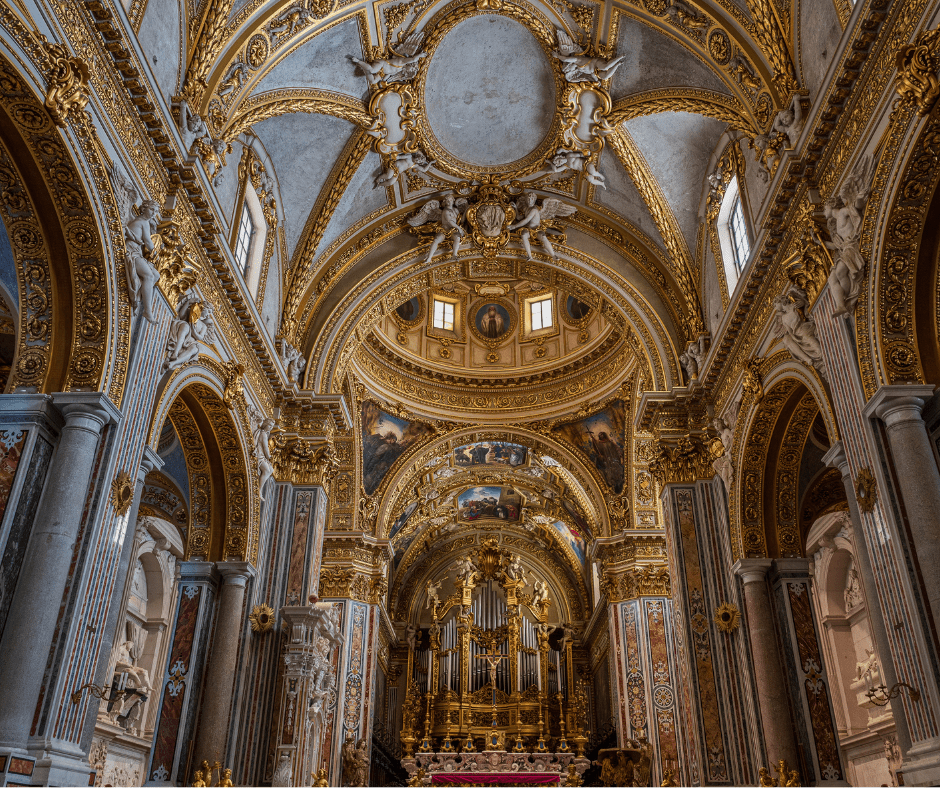
I sat in a Catholic church and a Baptist church in the space of this week. The Catholic church was semiotic heaven. Everywhere you looked was rich in symbolism, from multiple stained glass windows depicting Bible stories and Christian imagery. You couldn’t move without seeing something either in the furniture or the architecture that wasn’t deeply illustrative, in an artistic way. There was even a font at the entry for believers to dip their hands in to remind them of their baptism. I spoke to an atheist afterwards (it was a funeral), and he told me that despite not believing the building made him feel spiritual.
semiotics
/sɛmɪˈɒtɪks,siːmɪˈɒtɪks/
noun – the study of signs and symbols and their use or interpretation.
The second church I found myself in was a Baptist church in the northern suburbs of Brisbane. The auditorium was beige, the 70’s style cushioned pews were beige and brown. The stage had a big blue curtain backdrop. Absolutely zero symbolism. No cross, no art, no symbols, no signage. There was no clue to as to where we were. The auditorium could easily be mistaken for a venue for a librarian conference (with apologies to librarians). We have thrown the baby out with the bathwater when it comes to architecture, art, and semiotics.
We’ve put all our emphasis on the soaring, emotive worship set being inspiring and transcendent – and in many of our larger churches it is, for some. We bathe our congregations in darkness and the only symbolism is the elevation of a few people on the stage. The primary focal point is the bloke giving the sermon. This weekend I endured a 53-minute epic. Why? Because that is the primary focus.
A website called Ship of Fools runs a ‘Mystery Worshipper’ scheme, where people from around the world submit mystery worship reports (like mystery shopping reports). I may or may not be a secret reporter.
One report from October 2024 featured a church called Island Church of Poel, in the German town, Poel. One of the questions asked is: “Which part of the service was like being in heaven?” The answer was striking:
“This service was absolutely delightful for a variety of reasons. The sun was shining brightly; the 13th century red-brick Gothic church conveyed an atmosphere of awe, reverence and historical continuity; the precious 15th century altars, gilded with gold, provided artistic focal points; the well-crafted sermon was captivating from beginning to end; the organ, trumpet and trombones provided festive music; the congregational participation was spirited, and the artistic installation gave the church flair. This service was loaded with elements which produced what I would call a holy joy.”
You will go a long way to find Baptist architecture that can evoke a similar response. The best you can get is a traditional Baptist Tabernacle. That architecture is best described as ‘imposing’, in the best tradition of thunderous Baptist types. But they are few and far between. Modern Baptist architecture is very modern, and indistinguishable from other contemporary buildings.
3. Laity
As Baptists we profess that we believe in the ‘priesthood of all believers’, but it’s a massive fib. I’ve written at length about it here and here.
For as long as our theological institutions have existed their primary raison d-etre has been to train the priest class (pastors). Over least decade the spread of students has diversified as the supply of domestic pastoral candidates have dried up.
In terms of participation, in our church services we have a few singers (usually 3 at most), and then we have the main man, the pastor (preferably senior pastor), who holds forth for preferably 40 minutes minimum (for sermonettes produce Christianettes). A Catholic service on the other hand is multi voiced, thanks to multiple readings, a choir, and a range stewards who assist in various ways. Each service involves a small community of believers acting in a range of roles. The congregation isn’t bathed in darkness because they are very much a part of the worship.
Baptists do not provide any formal training for the majority of our leaders (elders & deacons). The reason is because our churches are all autonomous and our State denominational bodies use this as justification for not providing any training for lay leaders. This in their view is the responsibility of each church. The capacity of your average church to be able to do this is minimal. Therefore, the only formal training historically has been focussed on our priestly class (pastors).
Catholic training of laity is highly developed and ironically for an entity that has a priesthood – shows a greater commitment to the notion of the priesthood of all believers than us Baptists.
The Conversion
Sadly, for Thomas, my conversion isn’t ever going to happen. There are too many foundational beliefs I cannot forsake. Firstly, I reject the notion of an intermediary class of priests between us (the laity) and God. I believe that once the veil tore in two and Jesus’ sacrifice, the shedding of His own blood, was a sufficient atonement for sins. At that moment the need for a priesthood ended. The Holy of Holies was open for all people, for all time, both Jew and Gentile. The second biggie is transubstantiation. Nope. As for all the other reasons don’t get me started on Mary and the saints, confession and absolution, women in leadership and the rest. It aint gonna happen.
That doesn’t stop me from being envious though. Thankfully through my ministry role I am afforded the opportunity to experience multiple styles of worship. And just to keep Thomas hoping I may prioritise attending when he is ministering.
 Neobaptist
Leave a comment